The Solo Queue Grind: How to Turn Your Premier Matchmaking Journey into Engaging Stream Content
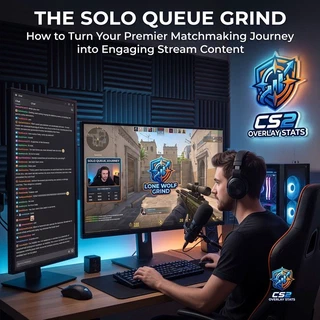 The Solo Queue Grind: How to Turn Your Premier Matchmaking Journey into Engaging Stream Content
Table of Contents
In the highly competitive landscape of Counter-Strike 2 streaming, creators often look for the perfect environment: a coordinated five-stack, flawless communication, and clean tactical execution. But let’s face the reality of the modern gaming landscape—most creators grind alone.
Hitting that “Look for Match” button completely solo in Premier matchmaking can feel like stepping into a mental war zone. You are at the mercy of the teammate roulette: muted players, toxic callouts, or completely mismatched playstyles.
However, where regular players see frustration, smart creators see pure entertainment value.
Comfort breeds complacency, and complacency kills stream retention. Audiences don’t just tune in to see flawless victories; they stay for the conflict, the human element, and the ultimate underdog story. Here is a definitive guide on how to reframe the chaotic CS2 Solo Queue experience into a compelling broadcast narrative that keeps viewers locked to their screens.
1. The Psychology of the “Lone Wolf” Arc
Every great story requires an objective and an obstacle. In Solo Queue, the obstacle is built inherently into the game client. Your job as a streamer is to clearly define the objective for your audience before the first pistol round even begins.
Instead of framing your broadcast as a casual, passive matchmaking session, turn it into a mission.
- Set the Stakes: Title your stream with a definitive micro-goal (e.g., “Breaking the 20K Premier Barrier Completely Solo” or “Solo Q Survival Guide: Can We Hit a 5-Win Streak?”).
- Create Empathy: Over 80% of your viewers have suffered through the same Solo Queue hardships. When you position yourself as the lone warrior fighting against the odds, every round win becomes a shared triumph, and every brutal defeat becomes a cliffhanger that makes people want to watch the next match.
2. Gamifying the Teammate Roulette
When a match starts spinning out of control due to uncooperative teammates, the worst thing a creator can do is toxic venting over the in-game voice chat. It ruins team morale and alienates viewers who tune in for positive or entertaining energy.
Instead, channel that chaotic energy directly into your stream’s interactive systems using Channel Points and Chat Predictions.
| Match Context Situation | Chat Interaction Prompt | Psychological Impact on Audience |
|---|---|---|
| The Echo Eco-Round | Prediction: “Will the team actually save or force-buy Deagles and no armor?” | Keeps chat highly active during secondary/low-investment rounds. |
| The Mid-Match Comeback | Prediction: “Can we recover from a 3-9 half with zero team comms?” | Dramatically increases emotional investment in the match outcome. |
| The Clutch Moment | Channel Points: Reward viewers for predicting if the unmuted teammate will give a fake callout. | Transforms a frustrating gameplay moment into shared humor. |
By gamifying the unpredictable nature of your teammates, you shift the narrative control back into your hands. You are no longer just a victim of bad matchmaking; you are the host of a high-stakes reality show.
3. Speak to the Stream, Not the Void
One of the most common pitfalls for solo streamers is falling into an intense, silent focus when their team stops talking. Dead air is the number one killer of viewer retention. If your in-game team is entirely silent, your stream chat must become your fifth teammate.
Treat your solo journey as an ongoing tactical breakdown. Speak your internal monologue out loud:
“Our blue teammate is pushing ramp without utility, so I need to hold this passive off-angle on A-site to catch the trade kill if he falls. Let’s see if the enemy team punishes this economy.”
By narrating your tactical decision-making process, you accomplish three critical things:
- You eliminate awkward silences.
- You invite experienced players in chat to debate your strategy, sparking organic conversation.
- You provide educational value to newer players, giving them a concrete reason to hit the follow button.
4. Visualizing the Struggle: Data as a Narrative Tool
When a new viewer clicks on your stream mid-game, they lack context. If they see you down 5-11 on the scoreboard, their initial assumption might be that the gameplay is low-tier or uninteresting, leading them to click away instantly.
This is exactly why providing immediate visual context is non-negotiable for solo creators.